
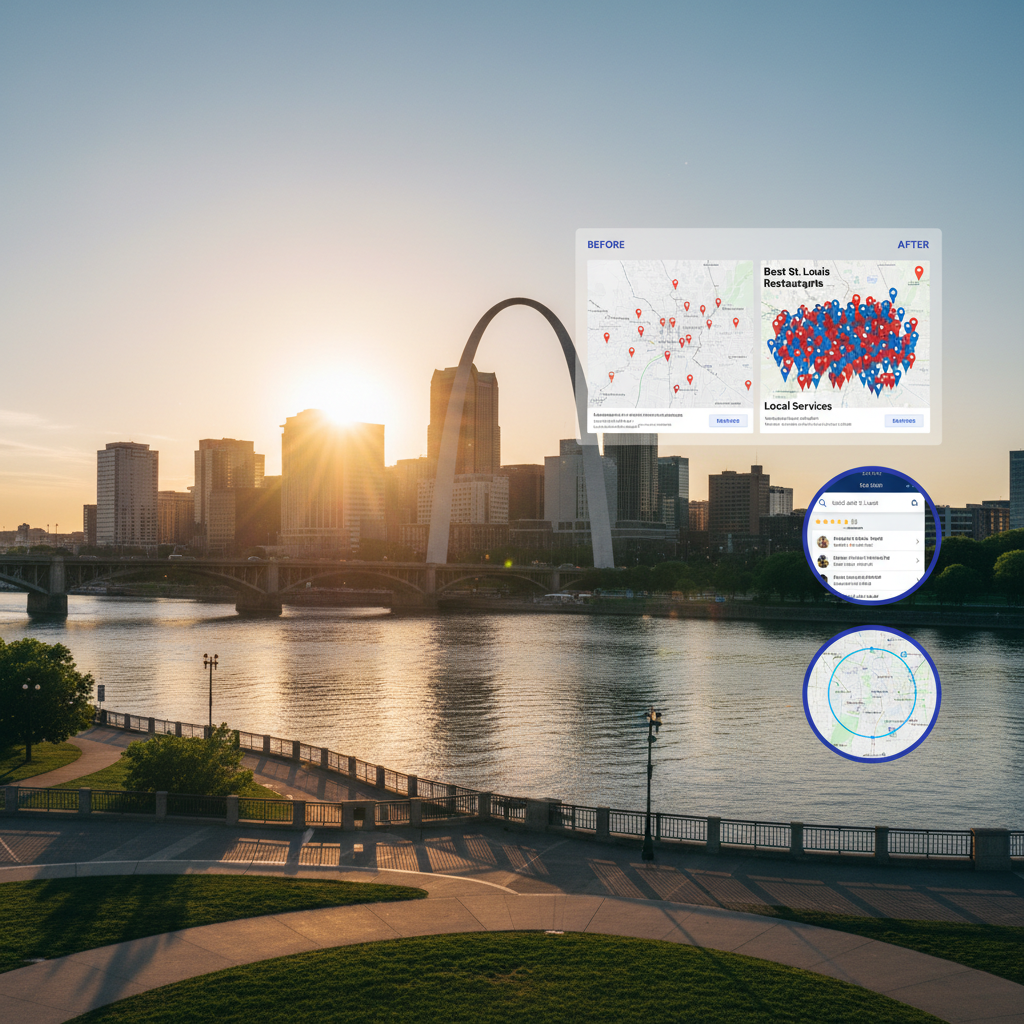
How to Master Local SEO in Greater St. Louis: A Complete 2025 Guide
Looking for your business when customers type "restaurants near me" or "plumber near me" in St. Louis? If you're not showing up, you're missing 46% of all Google searches that seek local information. At St Louis Near Me Directory, we've helped hundreds of Greater St. Louis businesses transform their local search presence from invisible to unstoppable.
Here's what you'll learn in this step-by-step guide: Google Business Profile mastery, voice search preparation, multi-location management, and crisis recovery - all tailored specifically for the Greater St. Louis market's unique characteristics.
What You Need Before Starting
Prerequisites for Local SEO Success:
- Active Google Business Profile (claimed and verified)
- Consistent business name, address, phone across all platforms
- Access to your business website backend
- High-quality photos of your business location and services
- 30 minutes weekly for ongoing maintenance
Common Starting Mistakes to Avoid:
- Using different business names across platforms
- Ignoring customer review responses
- Stuffing keywords into business descriptions
- Neglecting mobile website experience
- Choosing generic categories instead of specific ones
Step 1: Google Business Profile Domination
Your Google Business Profile is a critical tool for local businesses, playing a significant role in helping consumers discover and visit local stores. According to some reports, a well-optimized profile can significantly increase foot traffic.
Complete Your Profile Thoroughly
Google often prioritizes complete profiles, enhancing their visibility in search results. Fill out every available field:
- Business Description: Write 150-200 words focusing on what you do and where you serve. Include "Greater St. Louis" and specific neighborhoods like Clayton, Kirkwood, or Chesterfield.
- Categories: Choose one primary category that exactly matches your main service, plus 2-3 secondary categories for additional services.
- Attributes: Select all applicable attributes (wheelchair accessible, outdoor seating, etc.). These appear in search filters.
- Service Areas: Define specific zip codes or cities you serve rather than broad radius selections.
Photo Strategy That Converts
Including photos in your Google Business Profile can significantly impact consumer engagement. Businesses with a rich photo presence tend to receive more requests for directions and website click-throughs.
- Upload 10+ high-quality exterior and interior photos
- Add team photos showing real people
- Include work-in-progress shots for service businesses
- Update seasonal photos quarterly
- Use Google's recommended 720x720 pixel format
Google Posts and Q&A Management
Post weekly updates about services, events, or special offers. Recent posts signal activity to Google's algorithm. Monitor and respond to Questions & Answers - unanswered questions hurt your ranking.
Step 2: Voice Search Preparation for 'Near Me' Queries
The use of voice search has seen substantial growth in recent years, with a noticeable shift towards conversational queries. Google's insights indicate this trend, with many users asking natural language questions. St. Louis searchers might ask questions like "What's the best pizza place in Clayton?" or "Where can I get my car fixed near Lambert Airport?"
Target Conversational Keywords
Traditional SEO often targets short, precise keywords like "pizza Clayton MO." Voice search, however, leans towards more conversational phrases such as "best pizza restaurant near me in Clayton." Here's how to strategize for both:
- Natural Language Phrases: Include question-based content on your website like "What makes us the top choice for home repairs in West County?"
- Location Modifiers: Use neighborhood names, landmarks, and local references. "Near Busch Stadium," "West County mall area," "Downtown Clayton district."
- Service + Intent Combinations: Target phrases like "emergency plumber St. Louis," "same-day delivery Kirkwood," "24-hour service Chesterfield."
FAQ Content for Voice Queries
Create FAQ sections answering common voice searches:
- "How late are you open?"
- "Do you serve [specific area]?"
- "What's your best-selling [product/service]?"
- "How much does [service] cost in St. Louis?"
Step 3: Multi-Location SEO for Greater St. Louis Businesses
Operating multiple locations across St. Louis County, St. Charles County, and Metro East Illinois? Each location needs distinct local SEO treatment.
Location-Specific Landing Pages
Create separate pages for each location with unique content:
- Unique Local Content: Mention nearby landmarks, local partnerships, community involvement specific to each area.
- Location-Specific Reviews: Feature customer reviews that mention the specific location and surrounding areas.
- Local Staff Bios: Include team members who live or work in each area.
- Area-Specific Services: Highlight services particularly relevant to each location's demographics.
Citation Consistency Across Locations
Each location needs consistent Name, Address, Phone (NAP) across directories:
- Use the same business name format for all locations
- Include suite numbers consistently
- Use local phone numbers, not central switchboards
- Submit each location to area-specific directories (Clayton Chamber, Kirkwood business associations)
Step 4: Review Management and Reputation Building
Reviews influence 93% of local business decisions. Here's your systematic approach:
Review Generation System
- Ask at the Right Time: Request reviews immediately after positive service delivery or project completion.
- Make it Simple: Send direct links to your Google Business Profile review section via text or email.
- Follow Up: Send review requests 3-7 days after service completion when experience is still fresh.
- Incentivize Appropriately: Offer small thank-you gestures for honest reviews (follow Google's guidelines).
Response Strategy for All Reviews
Respond to every review within 24-48 hours:
- Positive Reviews: Thank customers by name, mention specific services, invite them back.
- Negative Reviews: Acknowledge concerns, offer solutions, provide contact information for resolution.
- Neutral Reviews: Thank for feedback, highlight positive aspects, address any concerns mentioned.
Step 5: Local Content That Connects with St. Louis Community
Content that mentions local events, landmarks, and community involvement ranks better for local searches.
Hyperlocal Content Ideas
- Seasonal St. Louis Content: "Preparing Your HVAC for St. Louis Winters," "Summer Festival Catering in Forest Park"
- Neighborhood Guides: "Best Coffee Shops Walking Distance from Clayton Metro Station"
- Local Event Coverage: Participate in or sponsor local events, then create content around your involvement
- Partnership Spotlights: Feature other local businesses you work with or recommend
Event-Based Content Calendar
Plan content around major St. Louis events:
- Cardinals season (April-October)
- Blues playoffs (April-June)
- Fair Saint Louis (July 4th weekend)
- Oktoberfest celebrations (September-October)
- Holiday events downtown (November-December)
Step 6: Technical Local SEO Foundation
Schema Markup Implementation
Add LocalBusiness schema to your website's code. This helps search engines understand your business information:
- Business name, address, phone
- Operating hours for each location
- Service areas and types
- Customer review ratings
- Accepted payment methods
Mobile Performance
50% of mobile users visit stores within one day of local searches. Your mobile experience must be flawless:
- Page Speed: Load in under 3 seconds on mobile devices
- Click-to-Call: Make phone numbers instantly clickable
- Easy Navigation: Simple menu structure with clear service categories
- Local Landing: Show location information prominently on mobile homepage
Step 7: Citation Building Strategy for Greater St. Louis
Local citations (mentions of your business name, address, phone) signal authority to Google. Focus on these tiers:
Tier 1: Major Directories
- Google Business Profile
- Apple Maps
- Bing Places
- Facebook Business
- Yelp
Tier 2: St. Louis-Specific Directories
- St Louis Near Me Directory (verified local platform)
- Visit St. Louis business directory
- St. Louis Regional Chamber directories
- Neighborhood-specific chambers (Clayton, Kirkwood, Chesterfield)
Tier 3: Industry-Specific Citations
Find directories specific to your industry that allow local business listings.
Step 8: Crisis Management and Recovery
Negative reviews or Google Business Profile issues can devastate local rankings. Here's your recovery plan:
Negative Review Response Protocol
- Respond Quickly: Address negative reviews within 2-4 hours during business hours
- Take Responsibility: Acknowledge the customer's experience without making excuses
- Offer Solutions: Provide specific steps to resolve their concern
- Move Offline: Invite them to call or email to discuss further
- Follow Up: Update your response once the issue is resolved
Google Business Profile Suspension Recovery
If Google suspends your profile:
- Request reinstatement through Google Business Profile support
- Provide documentation proving business legitimacy
- Remove any policy violations from your listing
- Wait 7-14 days for Google's review process
- Consider alternative verification methods if available
Pro Tips for St. Louis Local SEO Success
Neighborhood Targeting: Create separate content for different St. Louis areas. "West County" searchers have different needs than "South City" searchers.
Seasonal Adjustment: Adjust your service emphasis based on St. Louis seasons. HVAC companies should push heating services October-March and cooling April-September.
Metro East Integration: Don't ignore Illinois communities like Belleville, Collinsville, and Edwardsville if you serve Metro East.
Competition Monitoring: Check what local competitors are doing monthly. Use their successful strategies and identify gaps you can fill.
Measuring Your Local SEO Success
Track these metrics monthly:
- Google Business Profile Views: Increasing visibility in local search
- Website Traffic from Local Search: Google Analytics shows organic local traffic
- Phone Call Volume: Track calls from online sources vs. total calls
- Direction Requests: People actively visiting your location
- Review Velocity: New reviews per month (aim for 4+ monthly for active businesses)
Troubleshooting Common Issues
Problem: Not showing in map pack results
Solution: Verify your Google Business Profile is claimed, complete, and has recent activity (posts, reviews, photos)
Problem: Competitors ranking higher with fewer reviews
Solution: Check their citation consistency, website authority, and Google Business Profile completion percentage
Problem: Inconsistent local rankings across devices
Solution: Ensure mobile website performance matches desktop, check for technical SEO issues
Problem: Negative reviews impacting rankings
Solution: Increase positive review generation, respond professionally to all reviews, address underlying service issues
Frequently Asked Questions
How long does it take to see local SEO results in St. Louis?
Most businesses see initial improvements in 30-60 days, with significant results in 3-6 months. Consistent effort produces the best long-term results.
Should I focus on Google or other local directories first?
Start with Google Business Profile since it drives the most local search traffic. Then expand to other major directories and St. Louis-specific platforms like our directory at St Louis Near Me Directory.
How many reviews do I need to compete locally?
Aim for 25+ positive reviews to establish credibility, then maintain 4-6 new reviews monthly. Quality and recency matter more than total quantity.
Can I do local SEO without a website?
While possible using just Google Business Profile and directory listings, a website provides much better results and control over your online presence.
What's the biggest local SEO mistake St. Louis businesses make?
Inconsistent business information across platforms. Make sure your name, address, and phone number match exactly everywhere online.
📅 Upcoming Events & Webinars
Stay updated with our latest Local seo best practices Greater St. Louis Region events, workshops, and industry insights.
View Our Calendar →Related Resources
- St Louis Near Me Directory - Expert Resource
- Local seo best practices Greater St. Louis Region Data & Analysis
- Local seo best practices Greater St. Louis Region Presentation
- St Louis Near Me Directory Official Page
- Local seo best practices Greater St. Louis Region Events
- Local seo best practices Greater St. Louis Region Resources
- Local seo best practices Greater St. Louis Region GitHub Resources
- Local seo best practices Greater St. Louis Region Blog Post
- Local seo best practices Greater St. Louis Region Service Area Map


No comments:
Post a Comment
Note: Only a member of this blog may post a comment.